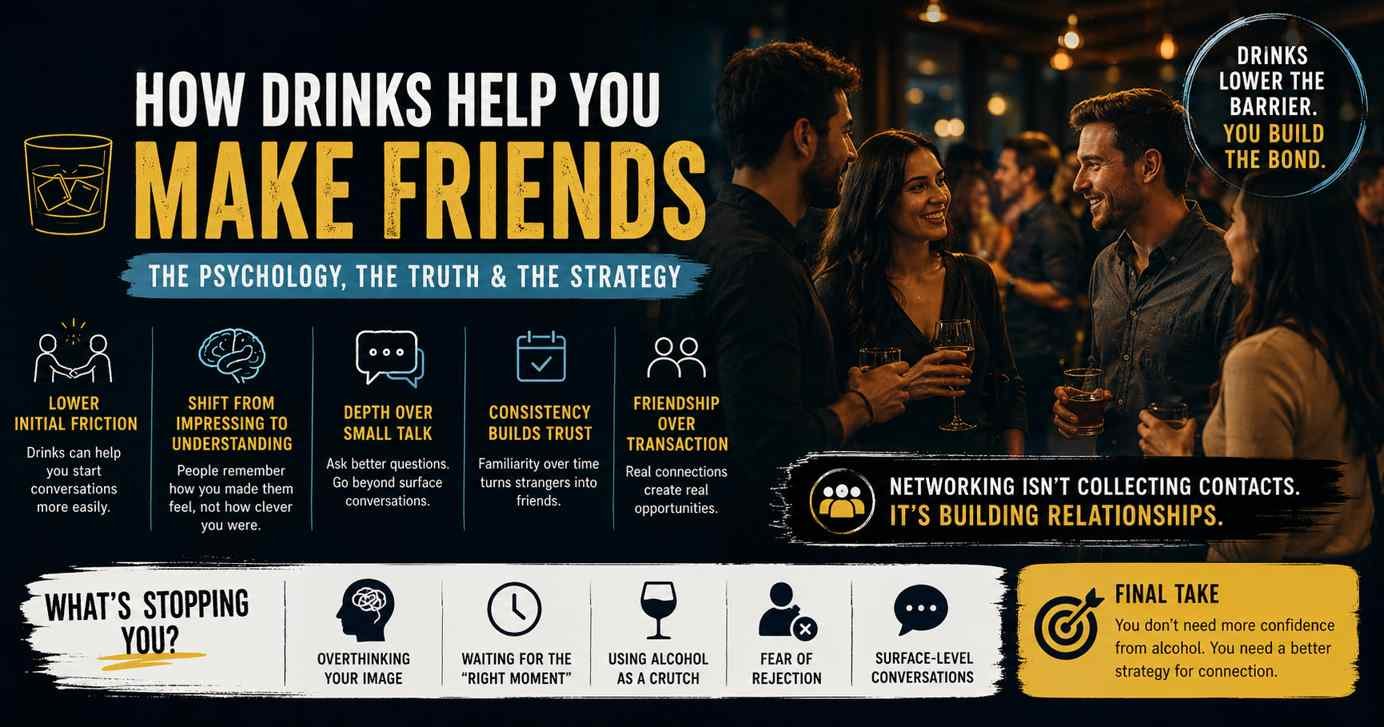
Walk into almost any professional mixer, startup meetup, or after-work event and you’ll notice a pattern: conversations don’t really start until the first drink is in hand. There’s a visible shift posture relaxes, voices loosen, eye contact increases. What felt slightly awkward minutes ago suddenly feels manageable, even easy. This is why drinks have become the default backdrop for networking. They create an environment where approaching strangers feels less like a risk and more like a casual move.
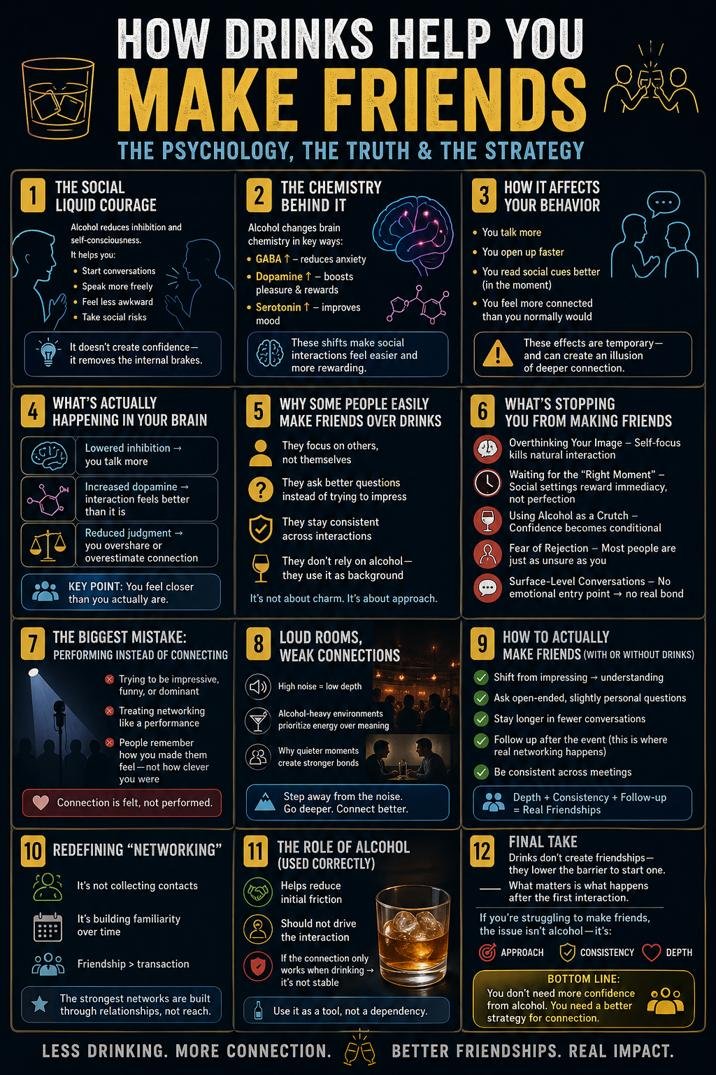
1. Opening Hook: The Illusion of Effortless Networking
That perception that drinks make connecting easier isn’t entirely wrong. Alcohol reduces social friction. It softens self-consciousness, quiets the internal filter that overanalyzes every word, and makes initiating conversation feel less like a calculated step. Instead of thinking “What should I say?”, people just start talking. In a setting where most attendees are strangers, that small shift matters. It lowers the barrier to entry.
But underneath this ease is a powerful, often unspoken belief: “Alcohol = instant confidence.” Not confidence built on clarity or self-assurance, but a temporary version driven by reduced inhibition. You feel more confident, so you act more confident. You speak more freely, laugh more easily, and engage without overthinking. From the outside, it looks like strong social skill. From the inside, it feels like you’ve finally “unlocked” your natural self.
The problem is that this confidence is state-dependent. It exists because of the chemical shift, not because your underlying communication skills have changed. Remove the drink, and the same environment may feel challenging again. This is where many people get stuck, they start associating effective networking with being slightly intoxicated, rather than with developing actual social competence.
More importantly, while alcohol helps you start conversations, it doesn’t ensure those conversations become meaningful. Lowering inhibition increases volume, not depth. You may talk more, but not necessarily better. You may feel connected, but that feeling isn’t always mutual or lasting. In fact, alcohol can blur judgment, making interactions seem more engaging or significant than they actually are.
This creates a subtle mismatch:
- In the moment, everything feels smooth and promising
- The next day, very few of those interactions translate into real follow-ups or relationships
Because meaningful connection requires more than ease, It requires attention, memory, emotional presence, and consistency. These are precisely the functions that alcohol can weaken when over-relied upon.
So yes, drinks make networking feel effortless. But that effortlessness is often surface-level efficiency, not depth. It helps you cross the first barrier starting a conversation but it doesn’t carry you through what actually builds friendships or professional relationships.
Understanding this distinction is critical. Otherwise, it’s easy to confuse feeling social with being effective socially and those are not the same thing.
2. The Real Function of Drinks in Networking
Alcohol plays a very specific role in social environments—it acts as a lubricant, not a builder. It reduces friction at the start of interactions, making it easier to approach, initiate, and sustain light conversation. In networking settings, this is valuable. It gets people talking who otherwise might stay guarded or silent.
But that’s where its strength ends.
Alcohol does not create the conditions required for real relationship formation. It doesn’t build trust, consistency, or emotional reliability, three elements that define whether someone moves from “person I met” to “person I know.”
What it actually creates is temporary ease.
You feel more open. Others seem more approachable. Conversations flow faster. There’s less hesitation, fewer awkward pauses, and a general sense that things are going well. But this ease is tied to the moment. Once the environment changes, different day, different state of mind. The connection often weakens or disappears entirely.
This is why many networking interactions feel strong in real time but fail to carry forward.
Another key function of alcohol in these settings is that it accelerates small talk. It compresses the early stages of interaction:
- Introductions happen faster
- Conversations jump quickly between topics
- People share more than they normally would early on
This creates the illusion of progress. It feels like you’ve moved beyond surface-level interaction, but in reality, you’ve often just moved through it faster, not deeper.
Depth requires:
- Attention
- Memory
- Intentional listening
- Follow-up
These are slower, more deliberate processes. Alcohol tends to disrupt them by shifting focus toward immediacy rather than continuity.
This is the core reason most “connections” made over drinks don’t convert into real friendships or meaningful professional relationships.
Because what’s missing is structural reinforcement:
- No repeated interaction
- No shared context beyond that one setting
- No continuation of the conversation
Without these, the interaction remains an isolated event, pleasant, but not durable.
There’s also a subtle overestimation effect at play. When inhibition is lowered, interactions feel smoother and more engaging than they objectively are. You may walk away thinking, “That went really well,” while the other person experiences it as just another casual conversation.
So the mismatch becomes clear:
- Alcohol helps you start faster
- But it doesn’t help you build stronger
Understanding this reframes networking entirely. Drinks are useful for breaking the initial barrier—but they are not a substitute for the slower, more intentional work of building a relationship.
If you rely on alcohol to carry the interaction, the connection will usually fade with the setting.
If you use it only to initiate and then focus on clarity, presence, and follow-up 3. The Psychology of Making Friends in Social Settings
Friendship isn’t built in a moment—it’s built through patterns. Social environments like networking events or nights out can spark introductions, but they rarely create lasting bonds on their own. The reason is simple: human connection follows predictable psychological mechanisms that require time, repetition, and emotional consistency.
Repeated Exposure: The Familiarity Effect
One of the strongest drivers of liking is the mere exposure effect—the more often we see someone, the more comfortable and positive we feel toward them.
- First interaction → neutral or slightly uncertain
- Second or third → recognition begins
- Repeated contact → comfort increases
This is why people you see regularly (coworkers, gym members, frequent attendees) are more likely to become friends than someone you had one great conversation with once.
Key point: Familiarity builds trust quietly over time, without needing intensity.
Shared Experiences: Context Creates Connection
People bond faster when they share context, not just conversation.
- Working on something together
- Attending the same events repeatedly
- Experiencing similar challenges or environments
These shared experiences create reference points:
- “Remember that event…”
- “We both went through…”
This transforms interaction from random to meaningful.
A single night out may feel engaging, but without shared context, it lacks continuity.
Emotional Safety: The Foundation of Real Connection
For a relationship to develop, there needs to be a sense of psychological safety:
- You can speak without being judged
- You’re not performing or filtering excessively
- The other person is consistent in behavior
Alcohol can simulate this temporarily by lowering inhibition, but real emotional safety comes from predictable, repeated interactions, not a one-time setting.
Without safety, conversations stay surface-level—even if they feel lively.
One Night ≠ Relationship
A common misconception is that a strong interaction equals a strong connection.
You might:
- Talk for hours
- Share personal stories
- Feel like you “clicked”
But without follow-up or repetition, that interaction remains isolated.
Relationships require:
- Continuation
- Reinforcement
- Consistency across different contexts
A single intense interaction creates memory, not relationship.
Why Familiarity Beats Intensity
Intensity feels powerful, but it’s unstable.
- High-energy conversations create excitement
- But excitement fades without structure
Familiarity, on the other hand, builds:
- Predictability
- Comfort
- Trust
This is why:
- Someone you see casually 10 times often becomes closer than someone you had one deep night with
- Slow, repeated interactions outperform fast, intense ones
Familiarity reduces effort. Intensity increases expectation.
What This Means in Social Settings
Most people approach networking or social drinking with the wrong goal:
They try to create a strong impression in a single interaction.
But psychologically, that’s inefficient.
A better approach is:
- Aim for recognition, not impact
- Prioritize repeat interactions over standout moments
- Focus on being consistent, not impressive
Final Perspective
Friendships aren’t formed through one great conversation—they’re formed through repeated, low-pressure interactions that build comfort over time.
Social settings can initiate contact, but they don’t complete the process.
If you understand that:
- Exposure builds familiarity
- Shared context builds meaning
- Emotional safety builds trust
Then it becomes clear why most “instant connections” fade—and why the strongest friendships grow slowly, almost unnoticed at first.that’s where real networking begins.
4. What’s Actually Happening in Your Brain
What feels like “better networking” after a drink is actually a shift in brain chemistry that changes how you perceive interactions—not necessarily the quality of those interactions.
Lowered Inhibition → You Talk More
Alcohol dampens activity in the brain’s control centers (especially the prefrontal cortex), which normally filter what you say and how you say it.
- You hesitate less before speaking
- You interrupt your own self-doubt
- You take conversational risks you’d normally avoid
This makes you more verbally active, which often gets mistaken for being more engaging or charismatic.
But increased output isn’t the same as better communication.
You’re speaking more freely—not necessarily more effectively.
Increased Dopamine → Interaction Feels Better Than It Is
Alcohol stimulates dopamine release, the neurotransmitter tied to reward and pleasure.
- Conversations feel more interesting
- People seem more likable
- The overall experience feels “high quality”
This creates a positive bias. You’re not just interacting—you’re enjoying the interaction more than you normally would.
The catch is that this feeling is internally generated. It doesn’t always reflect what the other person is experiencing.
Two people can walk away from the same conversation with completely different perceptions:
- You felt it was great
- They experienced it as average
Reduced Judgment → You Overshare or Overestimate Connection
With judgment lowered, your brain becomes less selective about:
- What you share
- How much you share
- When you share it
This often leads to:
- Early personal disclosures
- Faster emotional openness
- Less awareness of boundaries
In the moment, this can feel like rapid bonding. You think, “We really connected.”
But real connection isn’t just about openness—it’s about timing, mutuality, and context. Without those, sharing more doesn’t equal connecting more.
The Perception Gap
All three effects combine to create a gap between how the interaction feels and what it actually is.
- You talk more → feels like strong engagement
- You feel better → assume the interaction is better
- You share more → interpret it as deeper connection
But these are internal amplifications, not guaranteed external outcomes.
Key Point
You don’t necessarily become more connected, you feel more connected.
And that distinction is critical.
Because if you rely on that feeling as proof of real connection, you’ll consistently overestimate the strength of your relationships especially those formed in alcohol-driven environments.
Final Perspective
Alcohol changes:
- Your confidence
- Your perception
- Your emotional interpretation
But it doesn’t automatically improve:
- Your communication clarity
- Your listening quality
- Your long-term relational value
So while your brain signals, “This is going great,”
the actual connection may still be at a very early stage.
Understanding this helps you separate chemical confidence from real connection and that’s where more effective networking begins.
5. Why Some People Easily Make Friends Over Drinks
If you watch closely at any social or networking setting, a small group of people consistently seem to form connections with ease. They move between conversations naturally, people remember them, and interactions with them tend to continue beyond that one night.
It’s not luck, and it’s not just personality. It’s behavioral strategy.
They Focus on Others, Not Themselves
Most people enter social settings with an internal loop:
- “How do I sound?”
- “Am I interesting enough?”
- “What should I say next?”
This self-focus creates friction. It makes conversations feel effortful and slightly unnatural.
People who connect easily flip that orientation:
- They pay attention to the other person
- They listen actively instead of waiting to speak
- They respond to what’s being said, not what they planned to say
This shift does two things:
- It reduces their own anxiety (because attention is outward)
- It makes the other person feel valued—which is the foundation of connection
Result: Conversations feel smoother without trying to control them.
They Ask Better Questions Instead of Trying to Impress
Trying to impress is a losing strategy in social settings. It creates pressure, performance, and often shallow interaction.
Strong connectors do something different:
- They ask open-ended, slightly personal questions
- They follow up on answers instead of switching topics
- They show curiosity, not judgment
Examples:
- Not “What do you do?” → but “What do you enjoy most about what you do?”
- Not “Where are you from?” → but “What’s something about your city people usually get wrong?”
These questions:
- Move past surface-level quickly
- Create room for real conversation
- Signal genuine interest
Result: The interaction becomes memorable, not transactional.
They Stay Consistent Across Interactions
This is where most people fail.
They have a great conversation—but never follow up, never reconnect, or act completely different the next time they meet.
People who build friendships:
- Show up again in similar spaces
- Acknowledge previous conversations (“Last time you mentioned…”)
- Maintain a consistent tone and personality
Consistency builds:
- Familiarity
- Trust
- Recognition
Without it, every interaction resets to zero.
Result: They turn one-time meetings into ongoing relationships.
They Don’t Rely on Alcohol—They Use It as Background
This is a critical distinction.
Most people depend on alcohol to:
- Start conversations
- Maintain confidence
- Reduce awkwardness
But strong social connectors:
- Can engage without needing alcohol
- Use it only to smooth the environment, not control their behavior
- Maintain awareness and presence
Because they aren’t relying on alcohol:
- Their communication stays clear
- Their behavior remains consistent
- Their interactions are more reliable and easier to continue later
Result: The connection isn’t tied to the drinking environment—it survives beyond it.
What Separates Them Overall
They’re not louder, funnier, or more charismatic by default.
They’re simply:
- More attentive
- More curious
- More consistent
- Less dependent on external boosts
Final Perspective
Making friends over drinks isn’t about how much you talk or how confident you feel in the moment.
It’s about:
- How well you make others feel understood
- Whether you create continuity beyond the first interaction
- And whether your behavior holds up when the setting changes
The people who succeed socially aren’t using alcohol as a shortcut.
They’re using it as background noise while their actual skill is in how they connect.
6. What’s Stopping You From Making Friends
Most people assume the barrier is lack of confidence or social skill. In reality, it’s a set of predictable behavioral patterns that quietly block connection. These aren’t obvious mistakes—they feel reasonable in the moment—but they consistently prevent conversations from turning into relationships.
a. Overthinking Your Image
The internal loop starts before you even speak:
- “How do I sound?”
- “Am I interesting enough?”
- “Am I saying the right thing?”
This creates self-monitoring overload. Instead of engaging naturally, you’re managing your performance in real time.
The problem is attention.
When your focus is on yourself, you stop:
- Listening properly
- Responding authentically
- Picking up on social cues
Conversations lose flow because they’re being filtered instead of experienced.
Impact: You appear less present, even if you’re trying harder.
b. Waiting for the “Right Moment”
You see an opening—but you wait:
- For a perfect entry point
- For the conversation to slow down
- For confidence to “kick in”
That moment rarely comes.
Social environments move fast. Conversations shift, groups form, attention changes. By the time you decide to act, the opportunity has already passed.
People who connect easily don’t wait for perfect timing—they act on good enough timing.
Impact: Hesitation looks like disinterest, and you miss momentum.
c. Using Alcohol as a Crutch
Alcohol can reduce initial friction, but when it becomes your primary source of confidence, it creates dependency.
- You rely on it to start conversations
- You feel less capable without it
- Your social ability becomes tied to a specific state
This leads to inconsistency:
- Confident when drinking
- Reserved when sober
That inconsistency makes it harder to build stable connections because people experience different versions of you.
Impact: Your confidence becomes conditional instead of reliable.
d. Fear of Rejection
Rejection in social settings is rarely direct, but the fear of it is constant.
You might interpret:
- A short response as disinterest
- A distracted person as dismissive
- A pause as failure
So you withdraw early, before the interaction has time to develop.
The reality is:
- Most people are distracted, not rejecting you
- Many are equally unsure of what to say
- Conversations often start slightly awkward before they stabilize
Impact: You exit too early and mistake uncertainty for rejection.
e. Surface-Level Conversations
Safe topics feel comfortable:
- Work
- Weather
- Generic questions
But they rarely create connection because they lack emotional entry points.
Surface-level talk:
- Doesn’t reveal personality
- Doesn’t create memorability
- Doesn’t build continuity
To move beyond that, conversations need:
- Slight personalization
- Follow-up questions
- A shift from facts → perspective
For example:
- Not just “What do you do?”
- But “What do you actually enjoy about it?”
Impact: Conversations stay polite but forgettable.
What All of This Comes Down To
Each of these patterns creates the same underlying issue:
You’re either:
- Too focused on yourself
- Too cautious in action
- Or too shallow in interaction
All three prevent the one thing friendships require: natural, sustained engagement.
Final Perspective
Making friends isn’t blocked by lack of opportunity—it’s blocked by subtle behaviors that interrupt connection before it can develop.
- Overthinking disconnects you from the moment
- Waiting removes your chances to engage
- Dependency reduces consistency
- Fear cuts interactions short
- Surface talk prevents depth
Once you recognize these patterns, they become adjustable.
And that’s the shift:
You don’t need to become more interesting.
You need to remove what’s stopping you from being present, responsive, and real.
7. The Biggest Mistake: Performing Instead of Connecting
One of the most common reasons people struggle to build real connections in social settings is subtle but critical—they treat interaction like a performance.
Instead of entering a conversation to understand and engage, they enter it to impress.
Trying to Be Impressive, Funny, or Dominant
There’s an internal pressure to stand out:
- Say something clever
- Be the funniest in the group
- Hold attention
- Appear confident or high-value
On the surface, this seems like the right move. After all, being memorable feels like the goal.
But this approach shifts your focus from:
- Connection → Presentation
- Understanding → Impressing
When you’re trying to impress:
- You talk more than you listen
- You steer conversations toward yourself
- You filter responses based on impact, not authenticity
The interaction becomes one-directional, even if it feels active.
Result: You may get attention—but not attachment.
Treating Networking Like a Performance
Performance mode turns conversation into something you manage rather than experience.
You start:
- Thinking ahead instead of responding
- Measuring reactions instead of understanding them
- Adjusting your behavior to “land well”
This creates subtle tension. Even if you appear confident, the interaction lacks ease because it’s being controlled too tightly.
People can sense this.
Not consciously, but through cues:
- Slight disconnect in timing
- Lack of genuine curiosity
- Responses that feel rehearsed or strategic
Result: The interaction feels polished—but not real.
Why Performance Fails to Build Connection
Connection isn’t built on how impressive you are—it’s built on how safe and understood the other person feels.
When someone feels:
- Heard
- Respected
- Comfortable
They associate that feeling with you.
Performance, on the other hand:
- Creates distance
- Signals evaluation instead of openness
- Turns interaction into observation rather than participation
Even if you succeed in being entertaining, the relationship rarely progresses because it lacks mutual engagement.
People Remember How You Made Them Feel
This is the core principle most people overlook.
After a conversation, people rarely remember:
- Exact words
- Specific jokes
- Clever lines
They remember:
- Whether they felt comfortable
- Whether they felt interesting
- Whether the interaction felt natural
If someone walks away thinking:
- “That was easy to talk to them”
- “I felt understood”
- “That didn’t feel forced”
You’ve created a strong foundation for connection.
If they walk away thinking:
- “They were impressive”
- “They talked a lot”
That may earn short-term attention—but not long-term relationship.
The Shift: From Performing to Connecting
The difference is subtle but powerful.
Performance mindset:
- “How do I come across?”
- “How do I stand out?”
Connection mindset:
- “What is this person like?”
- “What are they actually saying?”
One is self-centered (even if unintentionally).
The other is interaction-centered.
Final Perspective
Trying to be impressive feels like the shortcut to connection—but it usually does the opposite.
It creates:
- Pressure
- Distance
- Artificial interaction
Real connection is quieter:
- It comes from attention
- It grows through ease
- It builds through consistency
You don’t need to be the most interesting person in the room.
You need to be the person others feel most comfortable being themselves around.
That’s what people come back to.
8. Loud Rooms, Weak Connections
There’s a reason many conversations in bars, clubs, and crowded events feel engaging in the moment but rarely turn into lasting connections. The environment itself works against depth.
High Noise = Low Depth
Loud environments increase cognitive load. Your brain has to work harder just to:
- Hear what’s being said
- Process fragmented sentences
- Maintain attention amid distractions
As noise rises, conversation naturally shifts toward:
- Shorter sentences
- Repetition (“What?” “Say that again”)
- Simpler topics
This limits how far a conversation can go. You’re not exploring ideas—you’re just maintaining basic communication.
Result: Interaction stays functional, not meaningful.
Alcohol-Heavy Environments Prioritize Energy Over Meaning
Spaces built around drinking are designed for stimulation:
- Loud music
- Crowded layouts
- Fast-paced interactions
Alcohol amplifies this by:
- Increasing volume and expressiveness
- Reducing attention span
- Encouraging rapid topic switching
The goal in these environments becomes:
- Keeping energy high
- Staying socially active
- Moving between people
Not:
- Understanding deeply
- Building continuity
- Creating emotional connection
Result: You get high engagement, but low retention.
Why Conversations Feel Good—but Don’t Last
In loud, alcohol-driven settings:
- You interact with more people
- You feel socially active
- You experience constant stimulation
This creates the illusion of strong connection.
But what’s missing is:
- Clear communication
- Memory of details
- Emotional grounding
So the next day:
- You remember the vibe
- But not the substance
Result: Many interactions, few meaningful connections.
Why Quieter Moments Create Stronger Bonds
When the environment shifts—lower noise, slower pace—everything changes.
- You can hear without effort
- You can think before responding
- You can stay on one topic longer
This allows:
- Better listening
- More thoughtful responses
- Subtle emotional cues to be noticed
Conversations become:
- More personal
- More specific
- More memorable
Result: Fewer interactions, but deeper ones.
The Role of Attention
Connection requires undivided attention.
Loud environments split attention across:
- Sound
- Movement
- Multiple conversations
Quiet environments consolidate attention:
- One conversation
- One person
- One thread of thought
That focus is what allows:
- Trust to begin forming
- Personal details to stick
- Conversations to evolve beyond surface level
What This Means in Practice
If your goal is real connection:
- Start conversations anywhere—but move them to quieter moments
- Step outside, shift locations, or slow the pace
- Prioritize continuity over variety (stay longer in fewer conversations)
You don’t need a completely silent setting—just one where you don’t have to fight the environment to communicate.
Final Perspective
Loud rooms are built for energy, not depth.
They’re excellent for starting interactions—but poor for sustaining them.
If you rely only on those environments, you’ll collect conversations, not connections.
Real bonds form where:
- Attention is stable
- Communication is clear
- And interaction isn’t competing with noise
That’s why the strongest connections often begin after you step away from the loudest part of the room.
9. How to Actually Make Friends (With or Without Drinks)
Most people approach social settings with the goal of making an impression. That’s inefficient. Friendship doesn’t come from being noticed—it comes from being understood and remembered over time. The shift is subtle but decisive: move from performing well in a moment to building continuity across moments.
Shift from Impressing → Understanding
Impressing is about how you appear. Understanding is about how you engage.
When you try to impress:
- You control the conversation
- You prioritize what you say next
- You aim for impact
When you aim to understand:
- You listen fully
- You respond to specifics
- You let the conversation evolve naturally
This changes the entire interaction. People don’t feel evaluated—they feel seen.
Outcome: Lower pressure, higher trust, more natural flow.
Ask Open-Ended, Slightly Personal Questions
Surface questions keep conversations alive. Better questions make them meaningful.
Instead of:
- “What do you do?”
Move toward:
- “What part of your work do you actually enjoy?”
- “How did you get into that?”
- “What’s been the most interesting part of your journey so far?”
The key is slight personalization, not intensity.
Why this works:
- It invites reflection, not repetition
- It reveals perspective, not just facts
- It gives the other person space to expand
Follow-up is critical. Most people ask one question, then pivot. Staying with a thread signals real interest.
Outcome: The conversation becomes memorable because it feels different.
Stay Longer in Fewer Conversations
A common mistake is maximizing the number of interactions.
- More people ≠ more connection
- Faster switching = shallower engagement
Depth requires time:
- Let conversations develop
- Sit with pauses instead of escaping them
- Allow topics to evolve naturally
When you stay longer:
- You move past initial small talk
- You create continuity within the same interaction
- You become easier to remember
Outcome: Fewer conversations, but significantly stronger ones.
Follow Up After the Event
This is where most people fail—and where real networking actually begins.
An interaction without follow-up is just a moment.
Follow-up turns it into a relationship trajectory.
Effective follow-up:
- Reference something specific (“You mentioned…”)
- Keep it simple and natural
- Don’t overcomplicate the message
Examples:
- Continuing a topic
- Sharing something relevant
- Suggesting a low-pressure next interaction
Timing matters—too late, and the context fades.
Outcome: You move from “someone I met” to “someone I know.”
Be Consistent Across Meetings
Consistency is what converts familiarity into trust.
- Show up similarly each time
- Maintain tone, energy, and behavior
- Acknowledge previous interactions
People build comfort when they can predict your presence.
Inconsistency creates friction:
- Confident one day, distant the next
- Engaged once, disengaged later
That breaks continuity.
Consistency doesn’t mean being rigid—it means being recognizable.
Outcome: Trust builds quietly over repeated exposure.
Final Perspective
Making friends isn’t about doing more—it’s about doing a few things correctly and repeatedly.
- Understand instead of impress
- Go slightly deeper instead of wider
- Continue the interaction beyond the moment
- Show up the same way over time
Alcohol can make starting easier, but it doesn’t change what actually builds connection.
What builds it is:
- Attention
- Continuity
- Consistency
Once you focus on those, making friends stops feeling unpredictable—and starts becoming a process you can control.
10. Redefining “Networking”
Most people approach networking as a numbers game—how many people they met, how many contacts they saved, how many conversations they had. That model is flawed.
Networking is not about collection. It’s about conversion over time.
It’s Not Collecting Contacts
Collecting contacts feels productive:
- You exchange numbers
- You connect on LinkedIn
- You add names to your network
But most of these connections never move beyond that initial interaction.
Why? Because contact ≠ relationship.
A contact is:
- A one-time interaction
- Context-dependent
- Easily forgotten
Without follow-up or repeated exposure, it has no structural value.
This is why people can attend dozens of events, meet hundreds of people—and still feel like they have no real network.
Key shift: Stop measuring success by how many people you meet. Start measuring by how many you see again.
It’s Building Familiarity Over Time
Real networking is built on familiarity, not intensity.
Familiarity comes from:
- Seeing the same people repeatedly
- Continuing previous conversations
- Being recognizable across contexts
Each interaction doesn’t need to be exceptional—it needs to be consistent.
Over time:
- Recognition turns into comfort
- Comfort turns into trust
- Trust turns into opportunity or friendship
This is why:
- Someone you’ve had 5 short interactions with often becomes more valuable than someone you had 1 long conversation with
Because familiarity reduces friction in future interactions.
Key principle: People don’t invest in strangers—they invest in known patterns.
Friendship > Transaction
Transactional networking focuses on:
- “What can this person do for me?”
- Immediate utility
- Short-term gain
This approach creates shallow, fragile connections.
Friendship-based networking focuses on:
- Mutual interest
- Long-term interaction
- Natural relationship development
When a connection feels like a transaction:
- People become guarded
- Conversations become strategic
- Trust weakens
When it feels like a relationship:
- People open up
- Opportunities emerge organically
- Interaction continues without pressure
Ironically, the most valuable professional networks are built indirectly through genuine relationships—not direct intent.
The Structural Difference
Transactional mindset:
- Fast
- Wide
- Short-lived
Relationship mindset:
- Slow
- Focused
- Durable
One optimizes for reach.
The other optimizes for retention.
Final Perspective
Networking isn’t about being known by many—it’s about being recognized by a few, repeatedly.
- Contacts don’t create value—relationships do
- Intensity doesn’t build connection—consistency does
- Transactions don’t sustain networks—familiarity does
If you shift from collecting people to building familiarity over time, networking stops feeling forced—and starts compounding naturally.
11. The Role of Alcohol (Used Correctly)
Alcohol can be useful in social settings—but only when its role is clearly defined and limited. The problem isn’t alcohol itself. The problem is when it moves from a background tool to the driver of the interaction.
Helps Reduce Initial Friction
At the start of any social interaction, there’s resistance:
- Uncertainty about how to begin
- Self-consciousness
- Overthinking
A drink can lower that barrier.
- You approach more easily
- You speak with less hesitation
- You feel less evaluated
This makes initiation smoother, especially in unfamiliar environments.
But this benefit is narrow—it applies mostly to the first few minutes of interaction, not the entire conversation.
Use case: Starting conversations, not sustaining them.
Should Not Drive the Interaction
Once the conversation begins, alcohol should step into the background.
If it becomes central:
- You rely on it to keep talking
- Your clarity drops
- Your listening weakens
- Your responses become less precise
At that point, the interaction is no longer built on awareness—it’s built on reduced control.
Strong connections require:
- Attention
- Memory
- Consistency
These decline as alcohol becomes the driver.
Key principle: If the quality of your interaction depends on continued drinking, the interaction itself is unstable.
If the Connection Only Works When Drinking → It’s Not Stable
This is the most important filter.
Ask a simple question:
Would this conversation still work if both of you were completely sober?
If the answer is no, then what you’re experiencing is:
- Context-dependent chemistry
- Not a durable connection
Signs of unstable, alcohol-dependent interaction:
- You wouldn’t initiate the same conversation sober
- The dynamic feels different outside that environment
- There’s no follow-up when alcohol is removed
Stable connections, on the other hand:
- Translate across settings
- Maintain consistency in tone and behavior
- Don’t require altered states to function
Reality check: Alcohol can start a connection, but it cannot sustain one.
The Correct Positioning
Think of alcohol as:
- A facilitator at the start
- A non-factor during the interaction
- Irrelevant to whether the connection continues
If it becomes:
- The source of confidence
- The reason the interaction works
- The condition for engagement
Then it’s no longer supporting the process, it’s replacing it.
Final Perspective
Used correctly, alcohol lowers the entry barrier.
Used incorrectly, it becomes the foundation and that foundation is unstable.
The goal isn’t to remove alcohol entirely.
It’s to decouple your ability to connect from your need to drink.
Because real connection:
- Works across environments
- Holds up without chemical support
- And continues long after the drink is gone.
12. Final Take
Drinks don’t create friendships, they simply lower the barrier to start one. They make the first step easier, the first conversation smoother, the first interaction less intimidating. But that’s where their role ends.
What actually determines whether something turns into a friendship is what happens after that first interaction.
- Do you continue the conversation later?
- Do you recognize and reconnect when you meet again?
- Do you build familiarity over time?
Without these, even the best initial interaction fades into a one-time memory.
The Real Issue Isn’t Alcohol
If you find it difficult to make friends in these environments, the problem isn’t that you need more drinks or more confidence from them.
It comes down to three core factors:
Approach
Are you trying to impress, or trying to understand?
Are you focused on yourself, or on the interaction?
Consistency
Do you show up again?
Do you follow up?
Do you remain recognizable across interactions?
Depth
Do your conversations stay surface-level, or do they move into perspective and personality?
Do you create moments that are memorable or just pass time?
Bottom Line
You don’t need more confidence from alcohol.
You need a better system for connection.
Because real friendships are not built in a single night.
They are built through:
- Repeated interaction
- Genuine attention
- Consistent presence
Alcohol may open the door but you’re the one who has to walk through it, return, and stay.
