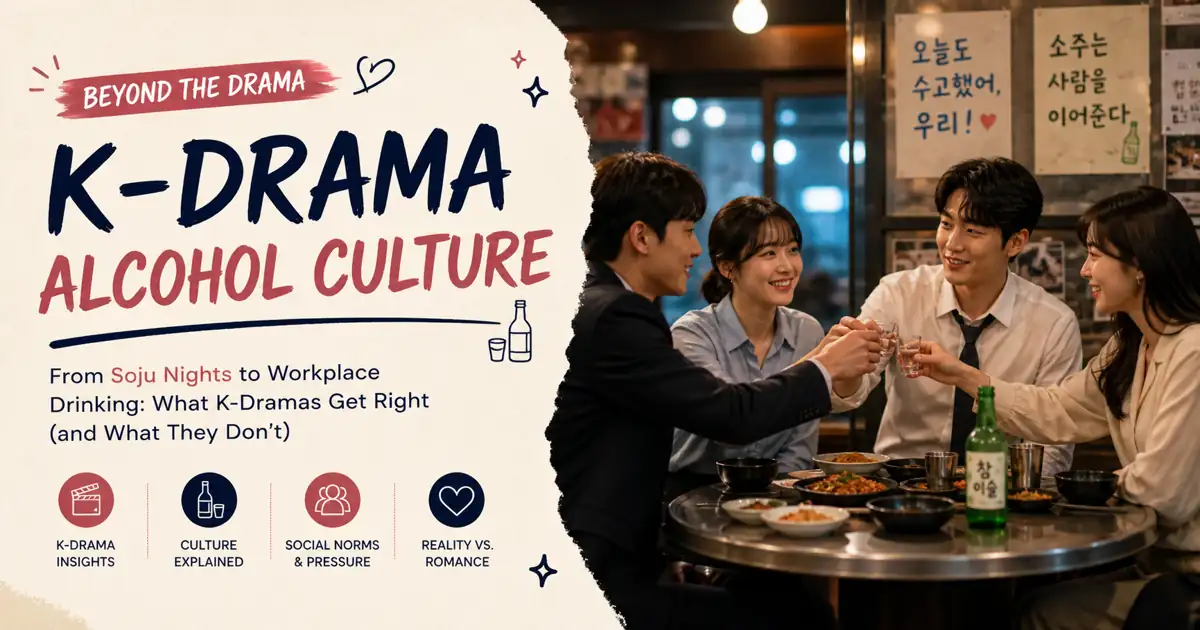
The Narrative and Cultural Architecture of Alcohol in South Korean Media: A Comprehensive Socio-Linguistic and Ethnographic Analysis
The global proliferation of South Korean media, colloquially termed the “Hallyu” or Korean Wave, has transformed the cultural landscape of international television consumption. Within this paradigm, Korean dramas (K-dramas) serve as primary vehicles for the transmission of social norms, linguistic patterns, and behavioral rituals. Among the most pervasive and influential of these cultural markers is the consumption of alcohol. In the domestic South Korean context, alcohol is far more than a beverage; it is a vital social lubricant, a mechanism for institutional cohesion, and a symbolic bridge between the internal psychological state and the external social hierarchy. Through meticulous narrative construction, K-dramas normalize and often aestheticize the act of drinking, positioning it as an indispensable tool for emotional catharsis, truth-telling, and the maintenance of interpersonal bonds.
Historical Foundations and Religious Rhythms of Alcohol Consumption
To understand the contemporary depiction of alcohol in K-dramas, one must first analyze its deep-seated historical and philosophical roots within the Korean peninsula. The production and consumption of alcohol, or sool, have been integral to the Korean way of life since the Three Kingdoms period (57 BC – 668 AD), where evidence suggests the early fermentation of rice-based spirits like mijiu, an ancestor of the modern makgeolli. These beverages were not merely casual indulgences but were essential components of Jecheon ceremonies—primitive religious rituals used to worship heaven and offer sacrifices for a successful harvest.
The Agrarian Cycle and Seasonal Spirits
Historically, the consumption of alcohol in Korea was intimately tied to the lunar calendar and the seasonal shifts of an agricultural society. Once the harvest concluded, farmers utilized their downtime to brew and ferment spirits, looking forward to the spring. This tradition established a cultural framework where alcohol served as a reward for hard labor and a celebratory marker of time. During the Seollal (Lunar New Year), Koreans consumed Dosoju, a medicinal liquor designed to fend off evil spirits and disease throughout the year. This wine was created by soaking powdered medicinal ingredients, such as balloon-flower root and Chinese peppers, in clear rice wine.
The fifteenth day of the first lunar month, known as Daeboreum, introduced the practice of drinking “ear-quickening wine” (Gwiryak-sul). Cultural belief dictated that this drink would ensure the consumer would hear only good news in the coming year. Even children participated in these rituals symbolically; while they did not consume the alcohol, they were encouraged to place their lips on the cup before the remaining liquid was poured down the chimney to deter sickness.
| Festival/Occasion | Traditional Beverage | Symbolic Intent/Meaning |
| Seollal (New Year) | Dosoju (도소주) | Fending off evil spirits and promoting health for the year. |
| Daeboreum (15th Day) | Ear-quickening wine | Facilitating the hearing of good news throughout the year. |
| Samjinnal (3rd Day/3rd Month) | Dugyeonju (두견주) | Celebrating spring with azalea flowers; a sweet flavor profile. |
| Dano (5th Day/5th Month) | Iris-infused wine | Chasing away diseases during the peak of Yang energy. |
| Chuseok (Harvest Festival) | Various rice wines | Symbolizing abundance, good fortune, and gratitude to ancestors. |
The Joseon Dynasty and the Formalization of Sool
The refinement of Korean alcohol reached its zenith during the Joseon Dynasty (1392–1897), where Confucian philosophy began to dictate the “proper way” of drinking, known as Judeok (the virtue of alcohol). This era saw the consolidation of the three primary traditional systems: Cheongju (clear wine), Takju (opaque wine), and Soju (distilled spirit). Alcohol was used as a political tool to maintain power relations within the royal court and as an essential item in state ceremonies.
The Choseonwangjosilok (Annals of the Joseon Dynasty) contains nearly 2,000 volumes detailing the use of alcohol in maintaining personal relationships and strengthening national power. During this period, the distinction between the ruling class and the commoners was reflected in their beverage choices; while the upper classes enjoyed high-quality Cheongju fermented for 21 days (known as Cheongmyeongju), the common people often consumed stronger, less refined Takju because high-quality brews were difficult to obtain outside the royal brewing house, the Yangonseo.
The Linguistic Fabric: Slang, Dialect, and Drinking Vernacular
K-dramas serve as a masterclass in the linguistic nuances of Korean drinking culture. The language used at the drinking table is a complex web of honorifics, contemporary slang, and emotional descriptors that reveal the social rank and intimacy of the participants.
The Nuance of Invitation: Hanjahada
The phrase Hanjahada (to have a simple drink) is perhaps the most common linguistic entry point into the drinking world of a K-drama. Derived from the words Han (one), Jan (cup), and Hada (to do), the term literally means “to do one cup”. However, the cultural implication is far broader, serving as a polite and friendly way to invite someone to share their time, whether over coffee, tea, or, most frequently, alcohol. In a drama, the invitation to Hanjahada often signals a turning point in a relationship—the transition from a professional or distant interaction to one of shared vulnerability.
Contemporary Slang and Hybrid Terminology
The modern Korean lexicon is replete with terms that describe the act of drinking, the state of inebriation, and the physical combinations of alcohol. Dramas frequently use shorthand like Somaek (soju mixed with beer) and Poktanju (bomb shots) to establish the energy level of a scene.
| Slang Term | Original Korean | Meaning and Context |
| Somaek | 소맥 | A mixture of soju and beer, considered smoother than straight soju. |
| Poktanju | 폭탄주 | “Bomb shot”; a shot of liquor dropped into beer. Often used for rapid intoxication. |
| Bulgeum | 불금 | “Fire Friday”; the practice of drinking and partying intensely on Friday nights. |
| Chimaek | 치맥 | A portmanteau of chicken and beer; popularized globally by dramas. |
| Aegyo | 애교 | Acting cute or using a baby voice, often exaggerated when a character is drunk. |
| Ikssip | 읽씹 | “Read and ignore”; a texting slang often discussed during “drunk texting” scenes. |
| Simkung | 심쿵 | A heart-fluttering moment, frequently occurring during post-drink confessions. |
Describing the Experience of Inebriation
The progression of drunkenness is also meticulously categorized in the drama vernacular. A character might be described as al-ttal-ttal-hae (tipsy), a casual term for being slightly affected by wine or beer. When the intoxication is complete, the term man-chwi is used to denote being “super drunk”. For those with a high tolerance, the term sul-gorae (alcohol whale) or sul-kkun (heavy drinker) is applied with a mix of awe and concern. Conversely, having a weak tolerance is referred to as sul-i-yak-hada, a trait often given to female leads to allow the male lead to step in as a “protector”.
One of the most evocative linguistic constructions found in K-dramas is the phrase pilleum-i kkeun-k-gida, which literally translates to “the film is cut” or “the film is broken”. This is used to describe a blackout, where a character has no memory of the previous night’s events—a trope used repeatedly to create suspense, humor, or embarrassment when a character realizes they confessed their love or made a scene while their “film” was cut.
Social Architecture: Hierarchy, Etiquette, and the Hwesik Ritual
The social hierarchy of South Korea is nowhere more visible than at the drinking table. K-dramas serve as a primary educational tool for viewers, depicting the intricate choreography of respect that governs how alcohol is served and received. These rituals are an extension of Confucian etiquette, where age and professional rank dictate every physical movement.
The Choreography of Respect: Pouring and Receiving
The physical act of drinking is a non-verbal conversation about status. According to traditional etiquette, which is depicted with strict accuracy in dramas, one must never pour their own drink. Instead, a junior or host must wait for a glass to be empty before refilling it, always using both hands as a sign of reverence. When pouring for a senior, the junior holds the bottle in the right hand while the left hand lightly touches the right wrist or chest.
The receipt of a drink is equally ritualized. A younger person receiving a glass from an elder must hold the cup with both hands—the left palm at the bottom and the right hand grasping the side—while slightly bowing their head. When it comes time to consume the drink, the junior must turn their head and body away from the elder, covering their mouth and the glass with their hands. This act of hiding the consumption of alcohol from a superior is a profound acknowledgment of the junior’s “less significant” status and a demonstration of modesty.
| Etiquette Rule | Physical Action | Symbolic Meaning |
| Two-Handed Pour | Right hand on bottle, left hand supporting right wrist/arm. | Humility and readiness to serve a superior. |
| Two-Handed Receipt | Left palm under the glass, right hand holding the side. | Respect for the elder or senior offering the drink. |
| Turning the Head | Rotating the body away from the senior while drinking. | Modesty; not consuming “directly” in the elder’s presence. |
| Clinking Etiquette | The rim of the junior’s glass must be lower than the senior’s. | Acknowledging professional or age-based rank. |
| Constant Vigilance | Filling a superior’s glass as soon as it is empty. | Demonstrating attention to the needs of the group/superior. |
The Hwesik Phenomenon: Institutional Bonding and Pressure
The Hwesik, or company dinner, is a “culture-heavy” gathering that serves as the nexus of corporate life and social drinking. In the professional world of a K-drama, Hwesik is portrayed as “mandatory fun”—an extension of the workday where attendance is crucial for career advancement. These events are designed to break down the rigid barriers between the “learned and the learners,” theoretically creating a sense of equality for a few hours.
However, the reality depicted in dramas is often more complex. The responsibility of juniors to obey seniors, combined with the “work hard, play hard” ethos, often results in “dangerous situations” where large quantities of alcohol must be consumed to show loyalty. Rejecting a drink from a superior is seen as “disrespecting the group atmosphere” and can have tangible consequences for one’s “work reputation”. This collective drinking culture is used to build bonds and maintain a “sense of community” within the “in-group,” but it also serves to reinforce the “collective identity” over individual preference.
Narrative Functions: Alcohol as a Truth-Telling and Bonding Device
In the narrative economy of a K-drama, alcohol functions as a catalyst for “truth-telling” (Jinsim). Because of the “East Asian low alcohol tolerance,” characters are shown to “loosen up” and “open up” more quickly than they would in a Western context, leading to a “drunk talk” culture where the mouth “rambles secrets” and “inhibitions are lost”.
The Sincerity Trope: Drunkenness and Romantic Breakthroughs
One of the most common tropes in K-drama romance is the “drunken confession.” Dramas consistently portray alcohol as a “relationship facilitator,” allowing the leads to circumvent the social rules that prohibit physical touch or emotional vulnerability. A “drunk scene” is almost never omitted from a romantic series because it provides a “way for the characters to show their true feelings”.
These scenes often lead to “more closeness and eventually romance,” as characters who are “less restricted by the rules” finally express their long-suppressed desires. In some cases, this leads to the “drunken one-night stand” trope, which acts as a plot driver for a subsequent “contract marriage” or forced relationship. Even when the outcome is less dramatic, the “unpretentious soju” serves to capture “female bonding the way it really happens in Korea”.
Solace and Escape: Convenience Stores and Soju Tents
Dramas like Queen of Tears highlight the use of alcohol as a “narrative device” for finding “solace”. Characters like Baek Hyun-woo find relief from the “difficulties of their marriage” or professional failures by sharing beers in front of a convenience store or inside a Pojangmacha (soju tent). These iconic street-side tents are portrayed as “cozy atmospheres” where characters can share “their deepest troubles” over “spicy stews and local anju”. This portrayal positions alcohol as a necessary “stress reliever” and an “anesthesia by which we endure the operation of life”.
Iconography and Dialogue: Analysis of Key Dramas
Certain K-dramas have become synonymous with specific drinking behaviors or philosophies. These productions do not just feature alcohol; they weave it into the thematic foundation of the story.
Itaewon Class: The Metaphor of Sweetness
The drama Itaewon Class utilizes the taste of soju as a recurring motif for the protagonist Park Saeroyi’s emotional state. The series establishes early on that “Dads are supposed to teach their sons how to drink”. When Saeroyi’s father asks him how his first shot of soju tastes, Saeroyi replies that it is “sweet.” His father laughs and explains that a sweet taste means he has had an “impressive day”.
However, as Saeroyi’s life is dismantled by the Jangga Group chaebol, the taste of soju changes to “bitter,” reflecting his “bleak future” and the “hellish place” he inhabits. His quest to open a pub named DanBam (Honey Night) is a literal attempt to make his “bitter night and my life sweet”. The eventual return of the “sweet” taste in the finale symbolizes his ultimate success and the resolution of his inner turmoil.
Work Later, Drink Now: The High-Functioning Reality
Work Later, Drink Now takes a more direct approach, focusing on a trio of women whose entire social life revolves around their “belief in one drink at the end of the day”. The show is lauded for its “fierce friendship” but has also drawn fire for its “problematic” depiction of alcohol dependence. One character, a variety show writer, asks, “Did the city make us drink or did our hard day make us drink?”—a line that resonates with the real-world pressure felt by urban professionals.
The drama presents a “cognitive dissonance” where characters are “high-functioning alcoholics” who can “ditch chemo and become cured by nature therapy,” only to return to “tossing back soju bombs” as soon as they are healthy. The writer Wi So-young defends this by stating that alcohol makes one “warm” and “sloppy,” allowing them to be “human” in a “sterile world”.
| Drama Title | Primary Alcohol Message | Key Dialogue/Quote |
| Itaewon Class | Alcohol taste as a barometer for life’s quality. | “How does it taste? It’s sweet. It means you’ve had an impressive day.” |
| Work Later, Drink Now | Drinking as a vital communal “healing” ritual. | “Did the city make us drink or did our hard day make us drink?” |
| Drinking Solo | The merit and peace of solitary consumption (Hon-sool). | “Drinking alone is an event unto itself. It’s a choice, a gift, not an escape.” |
| My Love From the Star | The “Chimaek” (Chicken + Beer) lifestyle as a romantic ideal. | “It’s perfect to have Chimaek on a snowy day!” |
| Moonshine | Historical perspective on the resilience of alcohol culture. | Explores the resourcefulness of bootleggers during Joseon-era prohibition. |
My Love From the Star: The Chimaek Craze
The 2014 series My Love from the Star is responsible for a global “Chimaek craze,” particularly in China. The female protagonist, Cheon Song-yi, famously declares, “It’s perfect to have Chimaek on a snowy day!”. This single line of dialogue sparked a surge in the popularity of Korean-style fried chicken and beer, demonstrating the immense “power of product placement” and the ability of dramas to shape global culinary and drinking habits.
The Cinematography of Sool: Lighting, Sound, and Visual Language
The promotion of alcohol in K-dramas is not limited to dialogue; it is deeply embedded in the “visual heartbeat” of the story through sophisticated cinematography. Directors use a “poetic language” of light and shadow to make the act of drinking appear “natural,” “aspirational,” or “vulnerable”.
The Technical Secret: Bokeh and Focal Length
A hallmark of K-drama drinking scenes is the use of “Bokeh”—the aesthetic quality of the blurred, soft, circular background lights that appear when using a large aperture. This technique, often achieved using focal lengths of 100mm+, creates a “creamy separation” between the characters and the environment, helping the “talent stand out” during an intimate conversation or confession.
Lighting is also carefully managed; for example, “low-key lighting” is used to accentuate shadows and create “high contrast,” heightening the tension or mystery during a “night talk”. Directors may even blast light through windows and “add fog in the background for texture,” making a simple walk home from a bar look “magnificent” and “cinematic”.
The Sensory Appeal of Sool
The “visual language” of soju often includes close-up shots of the “little green bottle,” with the camera lingering on the brand logo or the whirlpool created by a ritualistic “shake” of the bottle. The sound design is equally vital; the crisp sound of a can opening or the rhythmic clink of glasses (Jjan!) is used to “raise the bar” and “pull the audience in” before a single word is spoken. This creates a “cinematic nunchi”—a feeling of being attuned to the unspoken emotions of the scene.
Economic and Legal Frameworks: PPL and Broadcast Regulations
The pervasiveness of alcohol in K-dramas is partially driven by the economic reality of television production in South Korea. Because these shows often lack traditional commercial breaks, producers rely on “Indirect Advertising” (Ganjeop-gwanggo) or Product Placement (PPL) to supplement production costs.
The Role of HiteJinro and Marketing Giants
The brand Jinro is a “staple of everyday life” in Korea, dominating 66% of the soju market. Its bottles appear “naturally” in dramas like Goblin and Squid Game, much like a cup of coffee or a bowl of rice. This “organic” presence makes fans curious, leading them to seek out the product in overseas markets. HiteJinro has even enlisted celebrities with large overseas followings to promote its beverage, ensuring that when characters “are seen enjoying soju,” viewers “seek out soju” themselves.
Legal Restrictions and “Creative” Workarounds
The Korea Communications Commission (KCC) and the Broadcasting Act place strict regulations on how PPL can appear in entertainment programs.
| Regulation Category | Specific Legal Standard (Article 59-3 / Article 73) |
| Runtime Limit | PPL cannot exceed 1.5% of the total runtime of the program. |
| Screen Size | Brand names/logos cannot exceed 1/4 of the screen (1/3 for mobile). |
| Prohibition | Alcohol and tobacco cannot appear as official PPL in certain contexts. |
| Verbal Mentions | Brand names cannot be directly spoken by the cast. |
| Content Limits | Alcohol consumption cannot be linked to physical performance or driving. |
To circumvent the prohibition on alcohol as official PPL, producers often use bottles as “props” rather than “advertised products”. Marketers have found that “subtly planting an idea” is more effective than “blatant advertising”. For instance, a cast member might have a drink on their desk; if they consume it, the camera shifts focus to them naturally, which is “more effective than a regular ad” and avoids the “public backlash” associated with obvious commercialization.
Ethical Critiques and the Public Health Crisis
Despite the “positive valence” given to intoxication in K-dramas, the real-world impact of this culture is a subject of intense debate. Critics argue that these shows “familiarise young people with drinking” and “glamorise” what is essentially a serious drug.
The Double Standard: Alcohol vs. Smoking
A major point of contention among Korean health experts is the “double standard” between the depiction of smoking and drinking on television. While smoking is strictly “banned” and knives are “blurred by law,” drinking is depicted as “not only normal, but fully accepted”. This creates an environment where characters who are “doctor, pilots, and high-ranking officials” are shown as patients in withdrawal clinics, yet the media continues to present alcohol as the “cheapest way” to escape social pressure.
The KCSC and Legal Sanctions
The Korea Communications Standards Commission (KCSC) has begun to issue more frequent “warnings” and “cautions” to programs that “romanticize or encourage” excessive drinking. In 2024, the KCSC issued a sanction to the reality show I Live Alone for “repeatedly airing scenes of cast members drinking alcohol” and using “glorifying captions” like “Happiness in a full glass”. The commission emphasized that “public broadcasters have a duty to raise awareness about the risks of alcohol,” yet these shows often portray it as the “ultimate solution for fatigue”.
Conclusion: The Global Export of a Drinking Identity
The portrayal of alcohol in K-dramas is a powerful testament to the influence of media on cultural norms. By weaving alcohol into the historical, linguistic, and social fabric of their narratives, K-dramas have successfully normalized a highly specific set of drinking behaviors for a global audience. While these depictions offer a “warm” and “human” look into the complexities of Korean life, they also carry a heavy psychological weight, often masking the public health reality of a nation struggling with high rates of alcohol abuse. As the Hallyu wave continues to surge, the “green bottle” will likely remain a fixture of the global screen, serving as both a symbol of cultural sincerity and a subject of increasing ethical scrutiny. The challenge for the future of K-drama production lies in balancing the “narrative magic” of the drinking table with a responsible representation of its long-term societal consequences.
