Quick Answer
Yes, four shots of vodka is objectively a lot, representing four standard drinks that will push the average person well beyond the legal driving limit. You should expect significant impairment in coordination and judgment for at least three to four hours after consumption.
- Count your drinks in standard units, not just by the glass or shot.
- Never treat “tolerance” as a safety shield; your liver processes ethanol at a fixed, biological rate.
- Always consume food before drinking to slow the absorption of alcohol into your bloodstream.
Editor’s Note — Marcus Hale, Editor-in-Chief:
I firmly believe that the “shot culture” currently infecting modern bars is the single biggest threat to mindful drinking. It treats high-proof spirit as a commodity to be discarded rather than a liquid to be savored. In my years covering this industry, I’ve seen far too many enthusiasts mistake speed for enjoyment. What most people miss is that the neutrality of vodka is a trap; it masks the ethanol, leading to a rapid spike in blood alcohol that ruins your palate and your evening. Isla Grant understands the chemistry of the glass better than anyone. Order a slow-sipper and read her analysis.
The air in a dimly lit bar often carries the faint, sweet ghost of malt, or perhaps the sharp, medicinal bite of a freshly poured gin. But when the vodka comes out—clear, clinical, and aggressively cold—the sensory experience shifts. It’s a liquid designed to disappear. It doesn’t cling to the glass with legs like a fine cognac, nor does it carry the peat-smoke stories of a coastal Islay dram. It arrives as a blank slate, which is precisely why it is so dangerous.
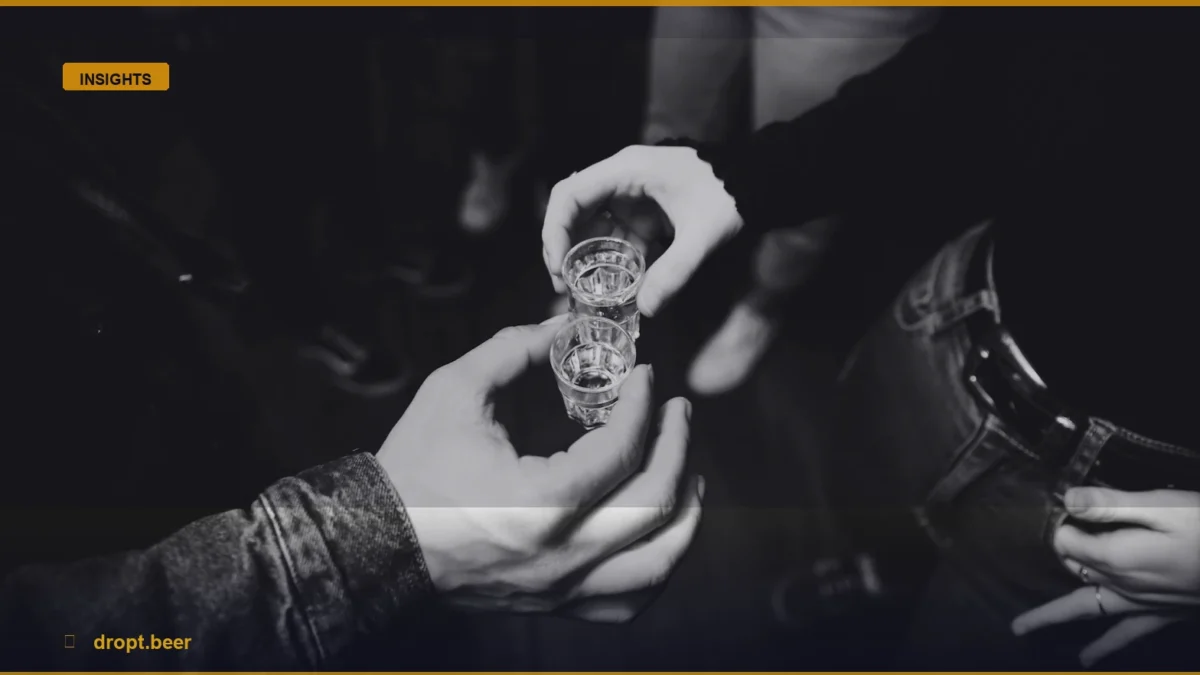
If you think four shots of vodka is a casual way to start an evening, you are dangerously mistaken. Four standard shots, each typically 1.5 ounces at 40% ABV, equate to roughly 2.4 ounces of pure ethanol. According to the WSET Level 1 Award in Spirits, this volume constitutes four distinct standard drinks. For the vast majority of adults, consuming this much alcohol in under an hour isn’t just “a bit of fun”; it is a physiological overload that will leave you legally impaired and cognitively diminished long before you realise what’s happening.
The Illusion of Tolerance
We love to talk about our “head for drink.” It’s a point of pride, a badge of honour worn by veterans of the pub circuit. But biology is stubborn. The liver metabolises alcohol at a fixed rate, governed by the enzyme alcohol dehydrogenase. It doesn’t care if you spent your twenties in the trenches of the craft beer movement or if you’ve never touched a drop. While a seasoned drinker might have learned to mask the outward signs of intoxication—the stumbling, the slurred consonants—the actual blood alcohol concentration (BAC) remains a cold, hard fact.
The BJCP guidelines for beer appreciation often emphasise the importance of pacing, and the same principle applies with clinical severity here. When you toss back four shots in rapid succession, you are essentially front-loading your system. Your liver can only process roughly one standard drink per hour. By the time you’ve finished that fourth shot, you’ve created a massive backlog of ethanol waiting for its turn to be processed. That surplus doesn’t vanish; it circulates, crossing the blood-brain barrier and hijacking your executive function.
Vodka’s Tactical Deception
There is a dangerous myth that vodka is somehow “lighter” or less potent than its brown-spirit counterparts. This is nonsense. Vodka is distilled to be neutral, which is exactly why it is the most efficient delivery vehicle for alcohol. Unlike a complex, cask-strength peated whisky that demands you slow down and engage with the layers of smoke and brine, vodka offers no resistance. It is the path of least resistance for your palate.
Consider the production. Many craft distillers pride themselves on a “clean” spirit, stripping away congeners. While this might lead to a cleaner morning-after, it does absolutely nothing to mitigate the immediate impact of the ethanol itself. Whether you are drinking a mass-market label or a boutique, potato-based craft vodka from a distillery in the Highlands, 40% ABV remains 40% ABV. If you are going to drink, drink for flavour, not for the speed of the buzz.
The Physical Cost of the Rush
When you cross that threshold of four shots, you aren’t just “feeling it.” You are entering a state of reduced motor coordination. Your reaction times sharpen into dullness. Your ability to make a sound decision—like whether to have one more or call a cab—is compromised. This is the moment where, if you were in a tasting room, you’d be missing the nuances of the glass entirely. You are no longer drinking thoughtfully; you are merely consuming.
If you’re looking to enjoy spirits, treat them with the respect they deserve. Reach for a glass that allows the spirit to breathe. If you must drink vodka, do so over ice, perhaps with a twist of lemon to provide the complexity that the distillation process intentionally removed. But above all, keep count. If you aren’t tracking your intake, you’ve already lost control of the night.
Ultimately, the goal of any drink worth having is to enhance the moment, not to erase it. If you find yourself at the bottom of a fourth shot glass, pause. Look around the room. Talk to the bartender about the provenance of the grain. If you can’t appreciate the drink, you shouldn’t be drinking it. For more guides on how to navigate the bar with intention, keep following the conversations here at dropt.beer.
Frequently Asked Questions
Does mixing vodka with soda water reduce the alcohol content?
No, mixing does not change the amount of ethanol you are ingesting. Adding soda water or juice only dilutes the concentration of the drink in the glass, making it taste less intense and potentially easier to consume quickly. However, the total volume of pure alcohol remains exactly the same. You are still consuming the same number of standard drinks, regardless of how much mixer you use to mask the bite.
Why does vodka seem to affect me faster than beer?
Vodka is typically 40% ABV, whereas beer is usually between 4% and 7% ABV. Because vodka is significantly more concentrated, it is much easier to consume a high volume of alcohol in a very short amount of time. Beer requires you to physically process a larger volume of liquid, which naturally slows your pace. Vodka’s neutral flavour allows you to bypass that natural slowing mechanism, leading to a faster, more intense spike in your blood alcohol concentration.
Does eating food really prevent getting drunk?
Eating food does not prevent intoxication, but it does significantly slow the rate at which alcohol is absorbed into your bloodstream. When you drink on an empty stomach, alcohol passes directly into the small intestine, where it is absorbed rapidly. Food in the stomach keeps the alcohol there longer, allowing the body to begin metabolising it before it hits your system all at once. It won’t keep you sober, but it will prevent a sudden, violent spike in impairment.
Is there such a thing as a “safe” amount of vodka to drink?
Safety is relative, but health organisations generally define moderate drinking as no more than two standard drinks per day for men and one for women. Consuming four shots at once exceeds these guidelines significantly. If you are drinking to enjoy the profile of a spirit, one or two measures sipped slowly is the standard for mindful consumption. Any amount that impairs your coordination or decision-making ability exceeds the threshold of responsible, thoughtful drinking.